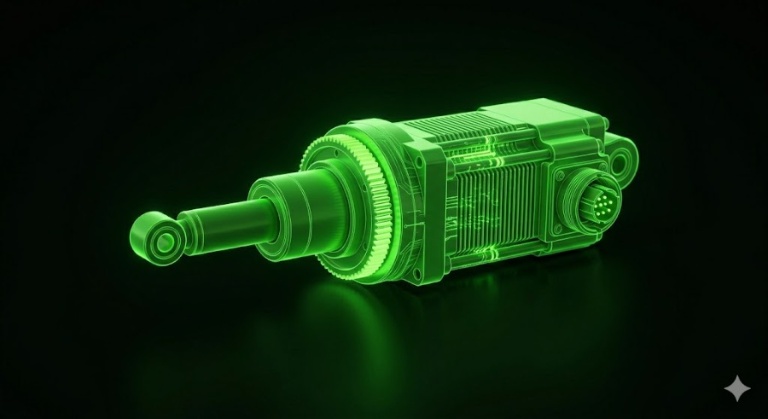
A standard interface for machines: what the Model Hardware Standard means for robot deployment
Anthropic's Model Hardware Standard gives AI agents one safe, discoverable way to talk to physical devices. It is the missing plug for the deployment protocol we run every day — here is how RosLab aligns with it.
On August 27, 2026, Anthropic opened a research preview of the Model Hardware Standard (MHS): a shared specification that lets AI agents discover and safely operate physical devices — microscopes, liquid handlers, robotic arms, and anything else with a programmable interface. What the Model Context Protocol did for software tools, MHS aims to do for machines.
Why this matters on a factory floor
Every deployment we run hits the same wall first: the hardware doesn't speak a common language. A gripper, a vision system, a conveyor, and a mobile base each arrive with their own SDK, their own error semantics, and their own tacit knowledge locked in a PDF manual. Weeks disappear into bespoke translators before anyone gets to the actual task.
MHS attacks exactly that. A standardized driver exposes simple primitives — read and write — plus a natural-language description of what a device can measure, what can be adjusted, and which safety limits are enforced. Devices become discoverable on the network, and an agent can pick up a machine it has never seen and operate it correctly. Integration time drops from months to hours.
How it aligns with the RosLab protocol
Our agentic Physical AI deployment protocol has always had three layers: a cloud brain that reasons and learns, a coordinator on the robot that decides the next step locally, and a safety-checked control layer that is the only thing allowed to move hardware. MHS slots directly into that third layer as the device interface — and it validates the design choice we already insisted on: the model never drives motors directly. Limits are declared by the device and enforced below the agent.
It is also model-agnostic and compute-agnostic, reachable over standard protocols. That matches how we build: no lock-in to a single GPU vendor, edge module, or model family. The same cell should run on whatever hardware the customer already owns.
The practical consequence for our deployments is a cleaner boundary. The RosLab data orchestration layer for Physical AI keeps doing what only it can do — routing real operational data from live cells back into evaluation and fine-tuning — while the device layer becomes a commodity that anyone can implement to a public spec. Less glue code, more time on the last mile.
What we're doing about it
- Modelling new integrations around read/write primitives and declarative safety limits, so they port cleanly once the standard is open source.
- Capturing machine knowledge — payloads, reach, calibration quirks — as structured natural-language metadata instead of tribal knowledge.
- Keeping the safety check between the agent and the actuators, independent of which standard wins.
- Feeding the data flywheel: every deployment produces real industrial data that improves accuracy for the next one.
The short version
Standards like MHS make the plumbing boring, which is exactly what production robotics needs. The hard part was never connecting a device — it is making a robot reliable outside the lab, week after week, on a real site. That's where our team lives.